Used Percussion Mill Sbm Austria for sale (10,507)
Sort results
- Lowest price Highest price
- Newest listings Oldest listings
- Shortest distance Farthest distance
- Newest year of manufacture Oldest year of manufacture
- Latest update Oldest update
- Manufacturer A to Z Manufacturer Z to A
- Relevance
- Lowest price
- Price
- Highest price
- Price
- Newest listings
- Release date
- Oldest listings
- Release date
- Shortest distance
- Distance
- Farthest distance
- Distance
- Newest year of manufacture
- Year of construction
- Oldest year of manufacture
- Year of construction
- Latest update
- Update
- Oldest update
- Update
- Manufacturer A to Z
- Manufacturer
- Manufacturer Z to A
- Manufacturer
- designation from A to Z
- Description
- designation from Z to A
- Description
- Model from A to Z
- Model
- Model from Z to A
- Model
- Lowest reference
- Ref.No.
- Highest reference
- Ref.No.
- Shortest runtime
- Runtime
- Longest duration
- Runtime
- Relevance
- Relevance
Listing
Piesing
1,653 km
Crushing unit
SBM8/6/2 XR Prallmühle
Call
Condition: refurbished (used), Year of construction: 1988, TECHNICAL DATA:
Jaw opening 200 x 620 mm
Year of manufacture 1988
Throughput capacity - 80 t/h
Feed material size 4-70 mm
Weight 6081 kg
Power requirement 90 - 132 kW
Special features: Adjustable grinding plates
Condition: Refurbished, wear parts replaced, sandblasted, primed, and painted
Ibjdpozc H Raofx Aknja
Optional and upon request: Infeed hopper, discharge hopper, motor, frame, V-belt, belt guard, control cabinet with soft starter or frequency inverter, special paint finishes, hydraulic opening mechanism
Listing
Piesing
1,653 km
Impact mill
SBM8/4/3 SM
Call
Year of construction: 1991, condition: ready for operation (used), functionality: unexamined, machine/vehicle number: 511 138K, Engine included.
Price upon request.
Iedpfszc Hp Ajx Aknjba
Listing
Germany
1,173 km
Rotor
SBM Hazemag16 22 6 und AP5 breit
Call
Year of construction: 1990, condition: defective spare-parts repository (used), -1- used rotor body for SBM 16 22 6 or Hazemag AP5 wide. Including 6 blow bars type HAZ 846 b (380x85x2250 mm, approx. 548 kg each), needs repair (see photos), year of manufacture unknown. Weight approx. 10 t, dimensions approx. 2250 x 1600 x 1600 mm.
Iodpfxey Au Nro Aknsba

Get information now
+44 20 806 810 84
+44 20 806 810 84
List now
*per listing / month
Listing
Warburg
1,191 km
Blow bars hammers
SBM01/58.001
Call
Condition: new, Year of construction: 2022, Hard chrome P1721, 233 kg/each, dimensions approx 1200 x 300 x 90 mm, directly available, subject to prior sales. For example SBM 12/12/4 RHS, or SBM Remax. Also martensitic on stock
Iodpfxolblz Nj Aknjba
Listing
Warburg
1,192 km
Crushing equipment
SBM10/10/4
Call
Condition: new, functionality: fully functional, Year of construction: 2022, Wearing parts SPECIAL OFFER for e.g. SBM 10/10/4 SM, consisting of:
1 pc. grinding plate 160790
4 pcs. spreader segment (2 x right / 2 x left) 05628
Isdpfxey Au Ihe Akneba
4 pcs. spreader segment (2 x right / 2 x left) 05629
Listing
Warburg
1,192 km
Crushing plant
SBM Vöest Alpine10/6/4 Exp
Call
Condition: used, functionality: unexamined, Year of construction: 1979, Various used housing parts for SBM-Vöest 10/6/4 Export
Iodpfoxv U S Rjx Aknoba
Listing
Warburg
1,192 km
Top cover
SBM12 12 4 RHS
Call
Year of construction: 2022, condition: new, -1- unused, top cover for impact mill SBM 12/12/4 RHS, unused top cover for SBM 12/12/4 RHS
Ibjdpfsu Spmpjx Aknsa
Listing
Đakovo
2,117 km
Sand Blasting/ Painting line
IKL - Austria400/2000
Call
Year of construction: 2013, condition: as good as new (ex-display), Technical Details :
- Sand Blasting + Liquid electrostatic painting line
- Manufacturer - IKL AUSTRIA
- Size of metal parts - max. 400x 2000 mm
- Two Robots
- Capacity - 400 bottles / day
Ijdpfxshtlw Rj Aknsba
- Line consists .
1. Sand Blasting line
2. Electrostatic painnting line
Listing
Đakovo
2,117 km
Pipe - tube production line
ERW -Austria
Call
Condition: good (used), Year of construction: 1992, Manufacturer - ERW
Year - 1992
Isdsdlqkqspfx Akneba
Range of round pipe - 21 - 76 mm
Range of square pipe - 20x20 - 60x60 mm
Sheet thickness - 0,8 - 3,5 mm
Speed - 60 m/min.
Lenght of line - 50 m
Tools : square pipes - 25,32,38mm
round pipes - 40, 51 mm
Welding power - 180 KW
Anode voltage - 14 kv
Anode dissipation - 70 kw
Frequency - up to 30 Mhz
Listing
Bevern
1,189 km
Air classifier filter system
SBM Combi SichterSemimobil 2 Fraktionen
Call
Condition: ready for operation (used), SMB Combisifter 10/32 + 32/60 2 fractions separates wood, plastic, foil and paper, wind sifting with filter system, 2 vibrating chutes, airlock, control cabinet with complete control system, mobile with hook trolley, self-erecting, compressor for filter cleaning, 1000 operating hours.
Ibsdpep Aunljfx Aknoa
Listing
Norderstedt
1,205 km
Multiple wire drawing machine - dry
SKET / MILL8 BLOCK
Call
Condition: used, functionality: fully functional, machine/vehicle number: D20E/7694, Offer Number: D20E/7694
Machinetype: multiple wire drawing machine - dry
Make: SKET / MILL
Type: 8 BLOCK
Constr. year:
inlet wire diameter: 6,5 mm
finished wire diamter: 1,6 mm
number of drafts: 8
diameter of capstan: 550 mm and 650 mm
Ibodpfxowi S Ixe Aknea
speed -meters/sek: 8-12
Location: Europe
Listing
Fumane (Verona)
1,630 km
Used complete pharmaceutical filling glass line - 3500 BPH
SIDE SBM
Call
Condition: used, Year of construction: 2000, machine/vehicle number: LC593, Used complete pharmaceutical filling glass line - 3500 BPHTechnical Specifications & Performance DataThis used bottling line is a complete, second hand pharmaceutical packaging solution designed for the filling and packaging of glass bottles for infusion-type applications. The line is currently in production and supports multiple dosage formats with integrated washing, filling, capping, crimping, sterilization, inspection, labeling, cartoning, and palletizing. Engineered for sterile handling, it uses purified water (PW), water for injection (WFI), and sterile compressed air in critical stages.Production speed: 3500 bottles per hourBottle volumes supported: 0.2L, 0.25L, 0.4L, 0.5LContainer type: Glass bottles (infusion/IV-style)Line configuration: Depalletizer, Bottle Washer (PW/WFI + sterile air drying), Filler, Vacuum stage, Bottle Capper, Aluminum Crimping Machine, Tray Loader, Autoclave, De-trayer, 2 x Manual Inspection Stations, Labeling Machine, Cartoning Machine, Carton Sealer, PalletizerSterilization: Autoclave by SBMOperation status: In productionAdvanced Automation & Control SystemsThe line features integrated handling and synchronized conveyors to maintain steady flow through washing, filling, closing, and terminal packaging stages. Manual visual inspection stations are positioned downstream of sterilization to ensure product quality. Format changeover is designed to handle multiple bottle sizes from 0.2L to 0.5L, enabling efficient batch transitions. Standard pharmaceutical best practices such as sterile air drying and clean utility segregation support controlled operations. Electrical parameters and PLC/HMI specifications are line-dependent and can be aligned with site utilities.Production Line Integration CapabilitiesAs a complete packaging line, this system operates in-line from depalletizing to palletizing. The upstream sections prepare and clean glass containers, the midstream modules manage accurate filling and secure closure with crimping, and the downstream area performs sterilization, inspection, labeling, case packing, sealing, and palletizing. The line offers multi-format flexibility for 0.2L, 0.25L, 0.4L, and 0.5L glass bottles and can be integrated with site-level quality systems and traceability procedures. Conveyors and accumulation zones are configured to balance cycle times across process steps.Machine Condition & Maintenance HistoryThe line is currently in production, indicating ongoing operability and maintained status. Washing with PW/WFI and sterile air drying underscores disciplined hygienic routines aligned with pharmaceutical processing. Regular operation across all stations—from depalletizer through palletizer—demonstrates a cohesive, production-ready asset suitable for immediate deployment after site adaptation.Operational Performance & VersatilityDesigned for glass bottles and sterile liquid products, the line combines precise filling with a dedicated vacuum stage and reliable closure via capping and aluminum crimping. The presence of an autoclave enables post-closure sterilization, while dual manual inspection stations provide visual particle control. The labeling, cartoning, ...
Iodsydpa Tspfx Aknjba
Listing
Vácegres
2,040 km
Hammer Mill machine with cyclone
Hammer Mill
Call
Condition: new, Year of construction: 2023, Hammer Mill with electrical box and cyclone filter for sale.
The machines has a CE certificate.
Technical parameters:
Electric motor power: 45Kw
Capacity: 1500-2000kg/hour
Machine size: 1750mmx900mmx1550mm.
Weight 1300kg.
Ibedpfx Aexf Nw Hoknsa
Located Locally in Hungary (EU)
Listing
Águeda
1,429 km
Single Head Wire Drawing Machine
MILLTV-100
Call
Condition: good (used), Single Head Capstan Block Wire Drawing Machine
Maximum Inlet Wire's Diameter: 30 mm
Ibsdst Ixkzepfx Aknja
Listing
Laakirchen
1,661 km
Radial arm saw Holzprofi RAS200Best-400V
Holzprofi AustriaRAS200
Call
Condition: new, The Holzprofi RAS200Best radial arm saw features a compact design for space-saving use in smaller workshops.
It is suitable for straight (90°), mitre (0° to 45° left) and bevel cuts (45° left and right) on wood-based panels and solid wood up to 3 m in length.
Ideal for use in furniture production and carpentry.
It is particularly user-friendly and a versatile addition to the sliding table saw for precise cutting work.
Advantages and features:
- Versatile: Swivel arm up to 45° to the left and right and tiltable cutting head (0° to 45° to the left, infinitely adjustable) enable a wide range of cutting operations and maximum flexibility.
- Safe: Noise-reduced full cover of the saw blade with safety switch, kickback protection, generously dimensioned work table and emergency stop button ensure optimum protection during operation.
- Robust: Sturdy steel construction with cast iron arm and base frame. Guides made of hardened, replaceable steel.
- Precise: Cutting head runs on 8 ball bearings – for smooth, precise and effortless movement.
Ibjdpex H Uk Dsfx Aknoa
Delivery without saw blade
Technical specifications:
Saw blade diameter 565 mm
Speed ?? 2800 rpm
Saw arm rotation +45° - -45°
L 45° 280x200, R 45° 470x200
Saw head tilt 0 - 45°
Cutting height at 90° 200 mm
Cutting height at 45° 135 mm
Cutting width 850 mm
Table size 1970 x 1285 mm
Motor power 5.5 kW S6 (4.5 kW S1) 400 V
Weight 360 kg
Desired equipment:
Laser
Listing
Malax
2,017 km
Drawer press
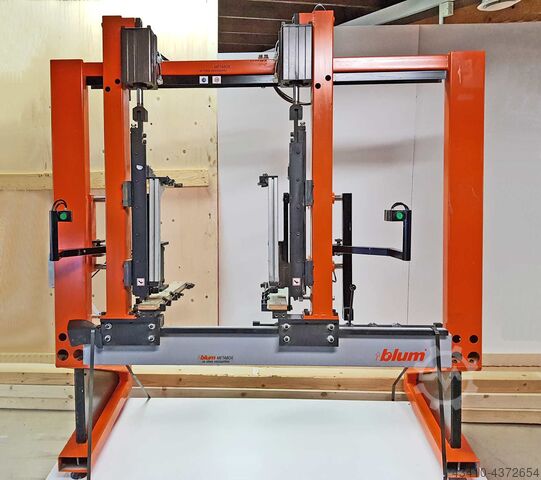
Blum AustriaBlum Metapress ZMM 3320
Call
Year of construction: 1995, condition: excellent (used), Blum Metapress ZMM 3320
Boxpress -Metabox
year 1995
S/N AA77
Length of runner min 270 mm, max . 650 mm
Carcase width min. 300 mm, max 1200 mm
Thickness of bottom min.13mm, max. 16 mm
Pneumatic press horizontal and vertical
for BLUM Metabox Systems
Ibsdpfxofgrgrj Aknea
Dimensions of machine LxBxH approx. 2000x1200x2000mm
in very good condition
Weight 700 kg
Listing
Mizil
2,659 km
Vertical machining center
HAITIAN - HISION - MAX MILLMAXMILL NVM1166 - HISION VMU1100 -V180
Call
Condition: repair required (used), Year of construction: 2019, functionality: fully functional, In operational condition: MAXMILL NVM1166 - HISION VMU1100 - HISION V180
Ibsdjy Iyw Sjpfx Aknea
Listing
Zheng Zhou Shi
8,710 km
Ball mill for powder and mining plant
Mingyuan Ball Mill For Fine PowderPowder grinding mill for coal, silica
Call
Condition: new, functionality: fully functional, power: 55 kW (74.78 HP), Year of construction: 2026, Ball Mill for Powder and Mining Plant: Structure, Function, and Technical Details
A ball mill is a key grinding machine widely used in mining, metallurgy, cement, chemical, and powder-making industries. It is designed to grind various ores and other materials into fine powder through impact and attrition between steel balls and the material inside a rotating cylindrical shell. In mining plants, ball mills are essential for ore beneficiation, preparing materials for flotation, magnetic separation, or leaching processes. In powder production, they ensure uniform particle size and high surface area for further processing.
Working Principle
The ball mill operates on a simple yet effective principle: as the cylindrical shell rotates around its horizontal axis, the grinding media (steel or ceramic balls) are lifted along the inner wall by centrifugal force and friction. When they reach a certain height, they fall freely, striking and grinding the material below. This repeated motion causes both impact and abrasion, reducing the material to the desired fineness. The grinding process can be performed in dry or wet conditions depending on the application.
Structural Composition
A standard ball mill consists of several main components:
Feeding part: Equipped with a feeder or screw conveyor to ensure uniform material input.
Discharging part: Can be grate type or overflow type, depending on the discharge method.
Rotating part: The cylindrical shell made of steel plates, lined with wear-resistant liners.
Transmission system: Includes motor, reducer, small transmission gear, and electrical control.
Grinding media: Steel balls or ceramic balls of different diameters for efficient grinding.
The internal liner design and ball size distribution are optimized to achieve maximum grinding efficiency and minimal energy consumption.
Technical Details
Typical Specifications:
Feeding size: ≤25 mm
Iedpoq Nf U Esfx Akneba
Discharge size: 0.074–0.4 mm
Capacity: 0.65–615 t/h (depending on model and material hardness)
Cylinder speed: 18–38 r/min
Power: 18.5–4500 kW
Liner material: High manganese steel, rubber, or alloy steel
Grinding media load: 30–45% of cylinder volume
Operating Modes:
Dry grinding: Suitable for materials that must remain moisture-free, such as cement clinker, limestone, and quartz.
Wet grinding: Common in ore beneficiation, where water or slurry improves grinding efficiency and particle uniformity.
Application in Mining Plants
In mining operations, ball mills are used after crushing to further reduce ore size and liberate valuable minerals. They are integrated into grinding circuits with classifiers, hydrocyclones, and flotation systems. The ground material is classified by size, and oversized particles are returned to the mill for regrinding. This closed-circuit system ensures consistent product fineness and efficient energy use.
Common Applications:
Gold, copper, iron, and zinc ore grinding
Cement clinker and slag processing
Silicate and ceramic powder production
Coal and mineral powder preparation
Conclusion
A ball mill is an indispensable piece of equipment in both powder production and mining beneficiation plants. Its ability to grind materials into fine, uniform particles makes it vital for downstream processes such as flotation, sintering, and chemical reactions.
Listing
Zheng Zhou Shi
8,710 km
Crushing equipment
Mingyuan Dry and Wet Ball MillCustomerizable Model for ball mill plant
Call
Condition: new, functionality: fully functional, Year of construction: 2026, Dry and Wet Ball Mill: Structure, Operation, and Technical Details
A ball mill is a fundamental grinding device used in mineral processing, cement manufacturing, chemical production, and other industrial applications. It works by rotating a cylindrical shell filled with grinding media—usually steel balls—causing impact and friction that reduce materials to fine powder. Based on the grinding environment, ball mills are classified into dry and wet types, each suited for specific materials and process requirements.
Working Principle
Both dry and wet ball mills operate on the same mechanical principle. The rotating cylinder, driven by a motor through a gear system, lifts the grinding media and material along the inner wall. As the rotation continues, the balls fall under gravity, striking and grinding the material. The difference lies in the presence or absence of a liquid medium during grinding.
Dry Ball Mill
A dry ball mill is used when the material must remain moisture-free or when water could affect product quality. It is commonly applied in cement clinker, limestone, quartz, and refractory material grinding. The discharge can be either grate type or overflow type, depending on the desired fineness.
Technical Features:
Feeding size: ≤25 mm
Discharge size: 0.075–0.4 mm
Capacity: 0.65–90 t/h
Liner material: High manganese steel or wear-resistant alloy
Drive system: Gear-driven or direct-coupled motor
Dust control: Equipped with air exhaust and dust collector
Advantages:
Suitable for materials sensitive to moisture
No drying process required after grinding
Lower corrosion risk and simpler maintenance
Easier material classification and separation
Limitations:
Dry grinding produces more dust and heat, requiring efficient ventilation and dust collection systems.
Wet Ball Mill
A wet ball mill operates with water or another liquid medium added to the material. The slurry formed during grinding improves efficiency by reducing friction and preventing excessive heat buildup. It is widely used in ore beneficiation, ceramics, and chemical industries.
Technical Features:
Feeding size: ≤25 mm
Discharge size: 0.074–0.2 mm
Isdpfx Ajq Nx Aleknsba
Capacity: 0.65–615 t/h
Liner material: Rubber or high-chromium steel
Discharge method: Overflow or grate type
Auxiliary equipment: Classifier, pump, and thickener for slurry circulation
Advantages:
Higher grinding efficiency and finer particle size
Reduced dust and noise levels
Continuous operation suitable for beneficiation circuits
Better control of particle uniformity
Limitations:
Requires drying if the final product must be in powder form and involves more complex slurry handling.
The selection between dry and wet grinding depends on the material characteristics, downstream process, and environmental conditions. Dry mills are preferred for materials that must stay moisture-free, while wet mills are ideal for fine grinding and slurry-based processes.
Conclusion
Dry and wet ball mills share the same mechanical structure but differ in their grinding environment and application scope. The dry type offers simplicity and low maintenance for moisture-sensitive materials, while the wet type provides higher efficiency and finer output for mineral and chemical processing. Understanding their technical parameters and operational differences ensures optimal equipment selection, improved productivity, and reliable performance in industrial grinding operations.
Listing
Zheng Zhou Shi
8,710 km
Crushing equipment
Hammer crusher /Hammer milllimestone, coal gangue,concrete crusher
Call
Condition: new, power: 55 kW (74.78 HP), Year of construction: 2026, A hammer crusher is a machine that uses high-speed rotating hammers to crush and break materials into smaller pieces. It is commonly used in various industries, including mining, cement, construction, metallurgy, and chemical processing. The basic principle of a hammer crusher involves a central rotor with hammers or blades that rotate and impact the material being crushed against a hard surface.
Here are the key features and components of a typical hammer crusher:
1. Rotor:
- The rotor is a central component of the hammer crusher. It usually consists of a shaft with multiple discs or hammers attached.
- The rotor's rotation causes the hammers to swing outward, impacting the material.
2. Hammers:
- Hammers are the striking or crushing elements attached to the rotor. They can be fixed or pivotally attached.
Isdpfx Akjq I Nxdonjba
- The material is crushed as the hammers impact it, generating kinetic energy.
3. Casing or Housing:
- The casing or housing encloses the rotor and hammers, providing structural support and safety.
- It also serves to contain the crushed material and direct it to the desired discharge point.
4. Grate Bars or Screens:
- Positioned at the bottom of the crusher casing, grate bars or screens control the size of the crushed material by allowing smaller particles to pass through while keeping larger ones inside for further crushing.
5. Impact Plate:
- Located near the bottom of the crusher, the impact plate absorbs the impact energy generated by the hammers and prevents excessive wear on the casing.
6. Drive System:
- The hammer crusher is powered by a motor connected to the rotor through a drive belt or coupling.
- The motor provides the necessary power to rotate the rotor, enabling the hammers to crush the material.
7. Adjustable Discharge:
- Some hammer crushers feature an adjustable discharge, allowing users to control the size of the crushed material by adjusting the gap between the impact plate and the hammers.
8. Applications:
- Hammer crushers are used for crushing a variety of materials, including coal, limestone, gypsum, aggregates, and various minerals.
- They are commonly employed in the mining industry for primary and secondary crushing of ore.
- In the cement industry, hammer crushers are used to crush limestone and other materials before they are mixed into the raw meal.
9. Maintenance and Safety:
- Regular maintenance is essential to ensure the efficient operation of a hammer crusher. This includes checking and replacing worn hammers, inspecting the rotor, and lubricating moving parts.
- Safety features, such as access doors and safety guards, are typically incorporated to prevent accidents during operation and maintenance.
Technical Specifications (Typical MINGYUAN Series)
Model Category,Max Feed Size,Capacity (t/h),Motor Power (kW),Rotor Speed (rpm)
Small (PC-400), ≤100mm, 5 – 10, 11, "1,000"
Medium (PC-800),≤200mm, 20 – 50, 55, 750 – 900
Heavy (PC-1200),≤350mm, 80 – 110, 132 – 160, 600 – 750
Heavy Hammer,"≤1,200mm", "500 – 1,000+ ","400 – 1,000" ,Variable
Listing
Zheng Zhou Shi
8,710 km
Mill / grinding mill
Batch Ball Mill, Silica grinding millQuartz ball mill, silica powder grinding
Call
Year of construction: 2026, condition: new, ceramic ball mill ,Batch ball mill ,also called ceramic ball mill ,it is used for fine grinding of feldspar,quartz,clay,ore and so on.The ceramic ball mill is mainly used for material mixing, grinding,uniform product fineness,and saving power.It can be dry or wet.The machine can use different liner types according to production needs to meet different needs.The fineness of the grinding operation is controlled by the grinding time
ceramic ball mill Working principle
when ball mill working,steel balls inside drum will rotate with the drum to some height,and then steel balls fall down with materials to reach the point of grinding.
Working Principle of Ceramic ball mill
ceramic ball mill ,Intermittent ball mill grinding operation is finished in the cylinder body. When the cylinder rotates, materials ascend to a certain height and then fall along a certain path due to the balls' gravity. Two forces are generated on the balls inside. One is the force on balls through tangent direction; the other is a opposite force in the contrast to the diameter of balls, as a result of the force generated when the balls slide down. These two forces will constitute a couple for the steel balls. The balls are squeezed between the cylinder and the adjacent steel balls, so the couple can make unequal-sized friction force. The balls will orbit along with the cylinder axis and then fall down, which can produce a strong impact force on the ores in the cylinder body and, as a result, the ores will be crushed. In conclusion, the ores in the cylinder body are mainly crushed by composite effect of peeling force, impact force and extrusion force.
Ceramic ball mill also named Intermittent ball mill which adopts the wet intermittent operation, is used for fine grinding and mixing the material such as feldspar, quartz, clay ceramic raw materials. The discharging and the mud size can through through 1000 sieve pore. This machine is high milling machinery, materials should be Broken in the fineness of the state into the grinding mill to get the highest efficiency and economic benefits.
The cement mill is key equipment for the grinding process of the cement clinker after the crushing process of it. It is mainly used in the cement silicate product industry. After long term design and manufacture of the cement mill, our company now has series of cement mill with various specifications to meet with different requirement from our customers.
Features of Cement Mill
Our company adopts suitable transmission methods according to different specifications. We have brim drive and center drive as transmission form. The cylinder adopts new type step lining to increase the grinding area. And it is easily repairable and changeable. The new designed separate-chambered structure adopts flexible lifting blade and fixed lifting blade and it is easily fixed and repaired.
Ibsdpfxsvzx Aue Aknea
Technical Details
We have different models and options for different requirements, please contact us for more info.
Trust Seal
Dealers certified through Machineseeker

Listing
Zheng Zhou Shi
8,710 km
Glass grinding machine
Henan Mingyuan Ceramic /Silica Ball MillBatch ball mill for glass ceramic making
Call
Condition: new, Year of construction: 2026, power: 7.5 kW (10.20 HP), Batch ball mills find applications in various industries where the processing of materials in discrete batches is required. The versatility of batch ball mills makes them suitable for a range of applications. Here are some common batch ball mill applications:
1. Ceramics Industry:
- *Glaze Preparation:* Batch ball mills are extensively used in the ceramics industry for preparing glazes. Raw materials such as feldspar, quartz, and clay are ground with ceramic balls to achieve the desired particle size for glaze formulation.
2. Chemical Industry:
Ijdoq I N H Nspfx Aknjba
- *Material Grinding:* Batch ball mills are used for grinding and blending various chemical materials. This includes the production of pigments, dyes, and other specialty chemicals where precise particle size control is crucial.
3. Pharmaceuticals:
- *Drug Formulation:* In pharmaceutical manufacturing, batch ball mills are used for grinding and blending powders to create drug formulations. The controlled environment provided by these mills is essential for maintaining the integrity of pharmaceutical compounds.
4. Food Industry:
- *Ingredient Mixing:* Batch ball mills may find application in the food industry for mixing and grinding ingredients. This can include the production of food additives, flavorings, and other powdered or granular products.
5. Mining and Minerals Processing:
- *Ore Grinding:* Batch ball mills are used in mining and minerals processing for grinding minerals and ores. The controlled grinding helps in obtaining the desired particle size for subsequent processes, such as mineral separation or extraction.
6. Paints and Coatings:
- *Pigment Dispersion:* In the paints and coatings industry, batch ball mills are employed for dispersing pigments into paint formulations. Achieving a uniform particle size is crucial for the quality and appearance of the final coating.
7. Building Materials:
- *Raw Material Grinding:* Batch ball mills are used in the preparation of raw materials for the production of building materials, such as cement and concrete. Grinding of materials like limestone and clay helps in obtaining the desired fineness for subsequent processes.
8. Electronic Materials:
- *Ceramic Powder Processing:* In the electronics industry, batch ball mills can be employed for processing ceramic powders used in the production of electronic components and insulating materials.
9. Research and Development:
- *Material Testing:* Batch ball mills are often used in research and development laboratories for testing and optimizing material formulations. They provide a controlled environment for small-scale processing and experimentation.
10. Customized Applications:
- *Specialized Processes:* Batch ball mills can be adapted for various specialized processes in different industries where precise grinding and mixing are required. Custom modifications can be made based on specific application requirements.
When using a batch ball mill, it's important to consider factors such as the type of material being processed, desired particle size, and the specific requirements of the end product. Additionally, following the manufacturer's guidelines and maintaining proper operating conditions are essential for efficient and effective milling processes.
Technical details
We have different options for different requirements, please contact our team for more info.
Listing
Zheng Zhou Shi
8,710 km
Cement mill,clinker grinding plant
Clinker grinding mill / cement ball millcement grinding with air classifier
Call
Year of construction: 2026, condition: new, functionality: fully functional, A cement clinker grinding mill is a specialized equipment used to grind the hard nodular clinker into fine powder, which is cement. Most cement is currently ground in ball mills and also vertical roller mills, which are more effective than ball mills.
Ijdpfx Akoq Nfbhjneba
Here are key features and information about cement clinker grinding mills:
1. Raw Materials:
- The main raw material for making cement is clinker, which is produced by sintering limestone and clay. Other materials such as gypsum, fly ash, or slag may also be added during the grinding process to achieve specific properties.
2. Grinding Process:
- The clinker and other additives are finely ground in the grinding mill to produce cement. The grinding process is a crucial step in cement production and contributes significantly to the final quality of the product.
3. Types of Mills:
- Ball Mills: Traditional ball mills are commonly used for grinding clinker. They operate by rotating a cylinder with steel grinding balls, causing the balls to fall back into the cylinder and onto the material to be ground.
- Vertical Roller Mills (VRM): VRM technology has become increasingly popular for clinker grinding. These mills use a rotating table with rollers to crush and grind the clinker, providing energy efficiency and a smaller footprint compared to ball mills.
4. Gypsum Addition:
- Gypsum is often added during the grinding process to control the setting time of the cement. It prevents flash setting of the clinker and facilitates the formation of a workable and pumpable cement paste.
5. Quality Control:
- Quality control measures, such as monitoring the fineness of the cement, chemical composition, and other properties, are implemented during the grinding process to ensure the final product meets the required specifications and standards.
6. Clinker Cooling:
- Before grinding, the clinker is produced by heating the raw materials in a kiln. The clinker is then cooled before entering the grinding mill to prevent excessive heat build-up during grinding.
7. Dust Collection and Environmental Considerations:
- Dust collectors and air pollution control systems are often employed to capture and control the dust generated during the grinding process, addressing environmental and safety concerns.
8. Packaging and Storage:
- After grinding, the cement is typically stored in silos before being packaged in bags or dispatched in bulk for distribution to construction sites or for sale in the market.
Cement clinker grinding mills play a crucial role in the cement production process, and advancements in technology continue to improve the efficiency and environmental sustainability of the grinding process.
Technical details
We have different options for different requirements, please contact our team for more info.
Listing
Zheng Zhou Shi
8,710 km
Powder grinding mill
ball mill for mining &fine powder makingsilica/Barite/limestone powder plant
Call
Condition: new, Year of construction: 2026, power: 300 kW (407.89 HP), Ball Mill for Mining & Fine Powder Making:
A ball mill is a fundamental grinding device widely used in mining, metallurgy, cement, and chemical industries. It is designed to grind ores and other materials into fine powder through impact and attrition between steel balls and the material inside a rotating cylindrical shell. In mining plants, ball mills are essential for ore beneficiation, while in powder-making industries, they ensure uniform particle size and high surface area for further processing.
Working Principle
The ball mill operates on the principle of impact and friction. As the cylindrical shell rotates around its horizontal axis, the grinding media—usually steel or ceramic balls—are lifted along the inner wall by centrifugal force and friction. When they reach a certain height, they fall freely, striking and grinding the material below. This repeated motion breaks down the material into fine particles. The process can be carried out in dry or wet conditions depending on the application.
Structural Composition
A standard ball mill consists of several main components:
Feeding part: Ensures uniform material input through a feeder or screw conveyor.
Discharging part: Can be grate type or overflow type, depending on the discharge method.
Rotating part: The cylindrical shell made of steel plates, lined with wear-resistant liners.
Transmission system: Includes motor, reducer, small transmission gear, and electrical control.
Grinding media: Steel or ceramic balls of various diameters for efficient grinding.
The internal liner design and ball size distribution are optimized to achieve maximum grinding efficiency and minimal energy consumption.
Ijdpfx Aeq Ngafokneba
Technical Details/Typical Specifications:
Feeding size: ≤25 mm
Discharge size: 0.074–0.4 mm
Capacity: 0.65–615 t/h (depending on model and material hardness)
Cylinder speed: 18–38 r/min
Power: 18.5–4500 kW
Liner material: High manganese steel, rubber, or alloy steel
Grinding media load: 30–45% of cylinder volume
Operating Modes:
Dry grinding: Used for materials that must remain moisture-free, such as cement clinker, limestone, and quartz.
Wet grinding: Common in ore beneficiation, where water or slurry improves grinding efficiency and particle uniformity.
Application in Mining and Powder Production
In mining operations, ball mills are used after crushing to further reduce ore size and liberate valuable minerals. They are integrated into grinding circuits with classifiers, hydrocyclones, and flotation systems. The ground material is classified by size, and oversized particles are returned to the mill for regrinding. This closed-circuit system ensures consistent product fineness and efficient energy use.
In fine powder production, ball mills are used to produce materials such as silicate, ceramic powder, refractory materials, and chemical raw materials. The uniform particle size achieved by ball milling enhances product quality and performance in downstream applications.
Conclusion
A ball mill is an indispensable piece of equipment for both mining and fine powder making. Its ability to grind materials into fine, uniform particles makes it vital for ore beneficiation and industrial powder production. With flexible configurations, high efficiency, and reliable operation, modern ball mills provide a cost-effective and energy-efficient solution for large-scale grinding, ensuring consistent quality and productivity across diverse applications.
Listing
Zheng Zhou Shi
8,710 km
Roll forming line
Rod ball mill / Rod Grinding MillFor Sand and mining beneficiation plant
Call
Condition: new, Year of construction: 2026, We have various kinds of ball grinding mill such as batch ball mill, rod mill, cement ball mill, mining ball mill, welcome to contact our team for further details according to your specific requirements.
Ibedpfx Ajq I Nw Ioknsa
We make it easier for you to find: "percussion mill sbm austria"
You will receive new offers immediately and free of charge via e-mail
You can easily terminate the search request at any time
This may be of interest to you

Get information now
+44 20 806 810 84
+44 20 806 810 84
List now
*per listing / month